

Your home has just settled slightly into the Utah soil. That’s normal. The real question is, has it settled unevenly, causing structural stress? That’s the difference between a home that’s peacefully aging and one that needs immediate attention.
After years of inspecting foundations across Utah—from the Wasatch Front to Salt Lake Valley to St. George—I can tell you that most homeowners don’t understand this distinction. They see a crack and panic. Or they ignore cracks that should have been addressed years ago. Neither response serves them well.
This guide cuts through the confusion. It explains what foundation settlement actually is, why Utah homes are particularly vulnerable to it, what signs actually matter, and when you should genuinely be concerned enough to call for an inspection.
What Foundation Settlement Actually Is
Foundation settlement sounds ominous. In reality, it’s almost inevitable.
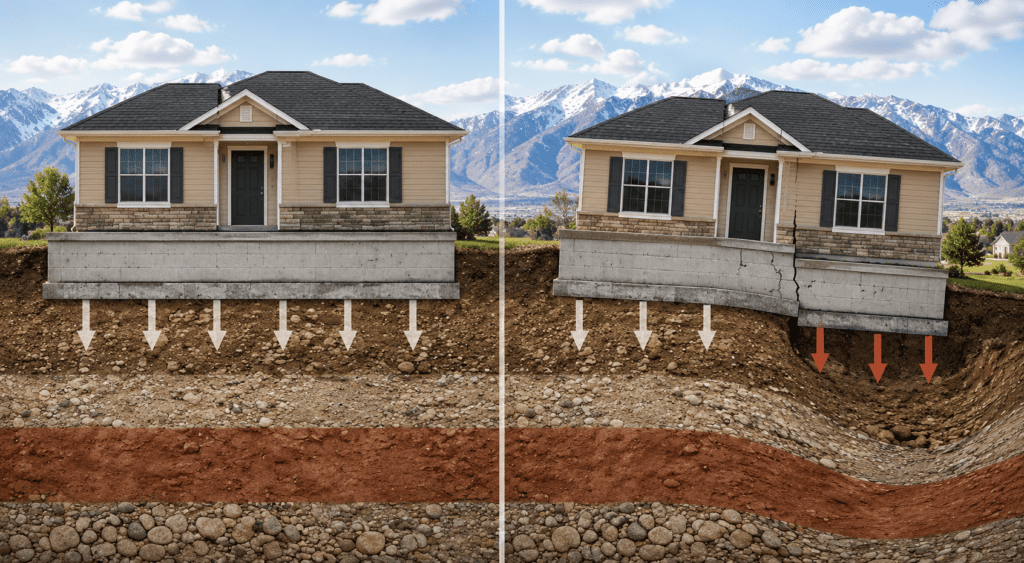
Your home’s foundation rests on soil. That soil compresses under weight. Over time—sometimes gradually, sometimes more quickly—the foundation sinks slightly into the soil. This is a settlement, and it happens to virtually every home built on compressible soil.
The keyword here is slight.
Uniform settlement happens when the entire foundation sinks evenly. Your home might sink an inch over five years, but it sinks as a unit. The structure stays level. Uniform settlement is normal and expected and generally causes no problems.
- Uniform settlement happens when the entire foundation sinks evenly. Your home might sink an inch over five years, but it sinks as a unit. The structure stays level. Uniform settlement is normal and expected and generally causes no problems.
- Differential settlement is the problem. This occurs when different parts of the foundation sink at different rates. One corner might settle more than another. One side of the house sinks while the other stays relatively stable. This creates stress on the structure. Walls crack. Doors and windows stop aligning with their frames. Floors become uneven. This is when you need to take action.
In Utah, differential settlement is particularly common because of our soils and climate.
Why Utah Homes Are Particularly Vulnerable
Utah’s foundation settlement problems aren’t random. They’re rooted in the state’s geology and climate.
Expansive Clay Soils
Much of Utah is built on clay soils—particularly the Wasatch Front, Salt Lake Valley, and surrounding areas. These aren’t ordinary clays. They’re expansive clays, meaning they change volume significantly with moisture content.
When clay soil is wet, it expands. When it dries, it shrinks. A 10-20% volume change isn’t unusual. For a foundation built on this soil, that’s significant stress. The foundation essentially moves up and down—and unevenly—throughout the year.
Seasonal Moisture Cycles
Utah’s climate creates perfect conditions for these expansion/contraction cycles:
- Spring: Heavy snowmelt saturates the soil around your foundation, expanding clay. Water pressure increases under the slab.
- Summer: Intense drought conditions dry out the same soil. Clay shrinks, creating voids beneath the foundation. The foundation can settle into these newly created gaps.
- Fall: Soil dries further, settlement continues, then occasional rains cause partial re-expansion.
- Winter: Freeze-thaw cycles crack concrete and further disrupt soil structure.
Repeat this cycle for 20, 30, or 50 years, and differential settlement becomes inevitable without proper drainage management.
Poor Drainage Decisions
Here’s what I see on nearly every site: a foundation built without adequate drainage protection, gutters that dump water directly onto the foundation, grading that slopes toward the house rather than away, or landscaping that traps moisture against the perimeter.
Each of these decisions compounds the settlement problem. Water that should drain away from the foundation instead infiltrates the soil immediately beneath it. The clay beneath becomes oversaturated while the clay 10 feet away from the house dries normally. Differential settlement accelerates.
The Real Signs You Should Worry About
Not every crack means your foundation is failing. But some signs absolutely warrant a professional inspection.
Cracks That Demand Action
- Horizontal cracks in basement or crawlspace walls - These are red flags. Horizontal cracks indicate lateral pressure from soil and water, not just settlement. If you see them, call for an inspection immediately. This often indicates hydrostatic pressure or serious structural stress.
- Diagonal cracks wider than 1/4 inch—Small diagonal cracks (hairline to 1/8 inch) are common and often cosmetic. But if a diagonal crack exceeds 1/4 inch in width, it’s evidence of significant structural movement. Get it inspected.
- Multiple cracks appearing in a short timeframe—If you notice several new cracks developing over weeks or a few months, this suggests active settlement. Stable cracks might not change for years. New, clustered cracks warrant professional evaluation.
- Cracks that are actively widening—Mark a crack with a piece of tape and the date. If the crack visibly widens over several weeks, you have active movement. Call us.
Physical Symptoms That Indicate Problems
- Doors and windows sticking or not closing properly - When frames become misaligned due to differential settlement, doors and windows stop fitting their openings correctly. This is one of the earliest signs homeowners notice, and it’s legitimate. The foundation has moved enough to shift the framing.
- Uneven or sloped floors - Walk across your basement or main floor and notice if it feels uneven or sloped. Pour a small amount of water on the floor—which direction does it flow? If floors are noticeably sloped or uneven, differential settlement has occurred.
- Bowing or bulging foundation walls - Basement walls that bow inward (concave) indicate lateral pressure from soil and water. This is serious and needs a professional assessment.
- Visible separation between the foundation and the house frame - If you can see daylight or gaps between the top of the foundation wall and the rim joist, settlement has occurred.
- Cracks in drywall or plaster, especially in corners - Cracks radiating from corners of windows and doors suggest structural movement in the framing caused by foundation settlement.
Signs That Are Typically Normal
Here’s what you should generally NOT worry about:
Small Hairline Cracks
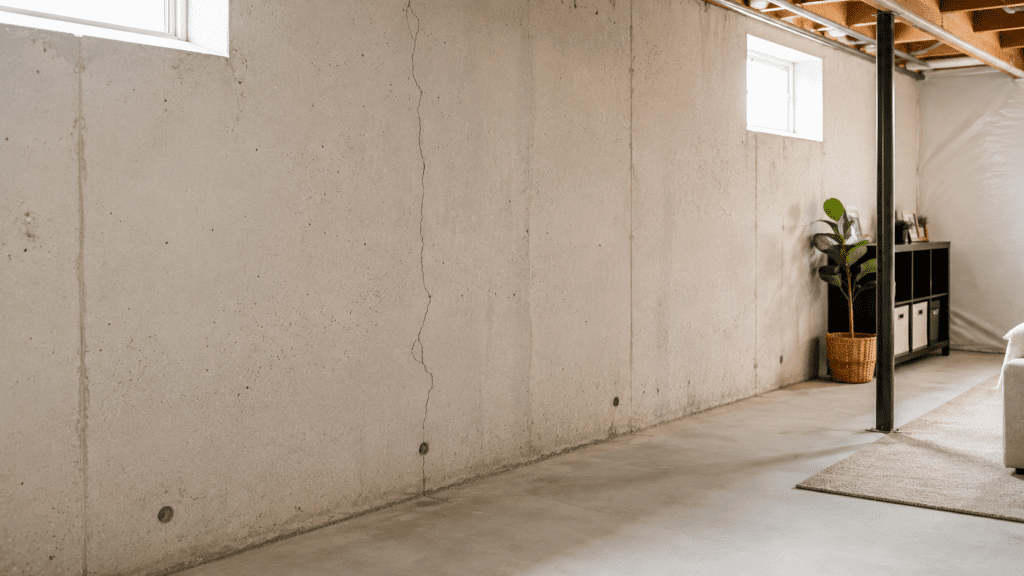
Cracks under 1/8 inch wide in concrete foundations are normal. Concrete shrinks as it cures. It also expands and contracts with temperature. Small cracks are cosmetic concerns, not structural ones. These do not require immediate action. However, if multiple small cracks appear together, or if one small crack is growing, that’s worth monitoring or calling about.
A Single Diagonal Crack That’s Stable
If you have one diagonal crack that’s been the same size for years and hasn’t grown, this is likely from normal settling or concrete curing. Continue to monitor it, but it doesn’t demand immediate action.
Very Fine Cracks in Finished Basement Walls
If your basement is finished and you notice fine cracks in the drywall or tape joints, it may be cosmetic settlement rather than structural failure. That said, if these cracks are appearing near a basement wall (close to the concrete), get them checked. If they’re in the middle of finished walls, they’re more likely to be cosmetic drywall issues.
When to Call for an Inspection (Our Honest Take)
Here’s my philosophy: not every sign is an emergency. But I’d rather you call when you’re unsure than ignore something serious.
You Should Call If You Notice the Following:
- Horizontal cracks (any size)
- Diagonal cracks wider than 1/4 inch
- New cracks appearing or existing cracks widening
- Doors or windows are sticking.
- Visibly uneven floors
- Water seepage in the basement
- Bowing or bulging walls
- Gaps between the foundation and the framing
You Could Monitor If You Notice the Following:
- Single small diagonal crack (hairline to 1/8 inch) that’s been stable for years
- Very minor cosmetic drywall cracks not near the foundation walls
- Occasional minor concrete dust (not active cracks)
Our Honest Reality:
A free inspection doesn’t cost you anything and takes 30-45 minutes. We’ve been doing this work across Utah for years. We can tell you in minutes whether something needs attention or is just normal settling. There’s no penalty for calling. Most homeowners who get an early inspection end up with cheaper, simpler solutions than those who wait.
What Causes Differential Settlement in Utah Homes
Understanding root causes helps you take preventive action.
Expansive Soil Shrinkage and Expansion
As I mentioned earlier, clay soils shrink and expand with changes in moisture. But this doesn’t affect the entire foundation equally. The side of the house with a downspout dumping water settles differently from the far side. The corner near a large tree (whose roots draw moisture from the soil) settles differently than the shaded north side, where the soil stays damper longer.
Water Intrusion and Soil Erosion
Water is the primary driver of foundation problems in Utah. When water consistently infiltrates soil around the foundation:
- Clay soils become oversaturated on one side while remaining dry on the other.
- Soil can actually erode or wash away in localized areas.
- Voids develop beneath the foundation.
- The foundation settles into these voids.
Inadequate Site Preparation
Older homes particularly suffer from this. Builders decades ago often didn’t compact fill soil properly or didn’t account for soil types. A foundation built on partially compacted fill settles faster and more unevenly than one built on undisturbed native soil or properly compacted fill.
Tree Roots and Moisture Removal
Large trees near foundations remove substantial moisture from the soil. Roots can extend 1.5 to 2 times the height of the tree. A 50-foot tree might have roots extending 75 feet horizontally, drawing moisture from soil beneath and around your foundation. The soil dries, the clay shrinks, and differential settlement occurs.
Plumbing Leaks
A slow leak in underground drainage or water lines near the foundation creates localized oversaturation. The saturated soil behaves differently from the nearby dry soil. Settlement becomes uneven.
What You Can Do: Prevention and Monitoring
While you can’t eliminate all settlement risk, you can dramatically reduce differential settlement through simple drainage and maintenance steps.
Manage Surface Water Aggressively
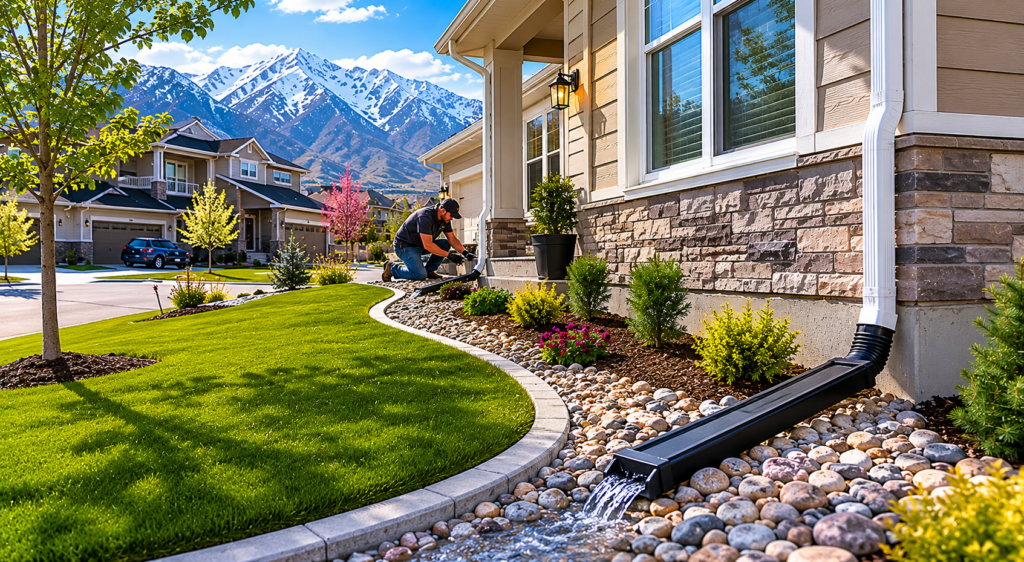
- Gutters and downspouts: Gutters should direct water away from the foundation, not down along it. Downspouts should extend at least 4-6 feet from the foundation. In Utah’s dry climate, many builders cut corners here.
- Grading: The ground should slope away from your house for at least 6 feet. A 5% slope (5 feet of drop per 100 feet) is ideal. Check this by observing where water flows after rain or during snowmelt.
- Landscaping: Don’t create low spots or planters that trap water against the foundation. Don’t mulch against the foundation wall.
Monitor Foundation Conditions
- Walk your foundation perimeter monthly, especially in spring (after snowmelt) and summer (during drought).
- Look for new cracks or changes in existing ones.
- Check basement or crawl space walls for seepage.
- Note any changes in door/window operation.
Address Plumbing Issues Quickly
Even small leaks matter when it comes to foundations. If you notice:
- Unexplained soft soil near the foundation
- Efflorescence (white powdery mineral deposits) on foundation walls
- Musty smells near the foundation
- Sudden changes in soil moisture
Call a plumber to check for leaks. A $200 plumbing inspection is cheap insurance against a $10,000 foundation problem.
Tree Management
If you have large trees within 30-40 feet of the foundation:
- Have a certified arborist assess the extent of their roots.
- Consider removal if the tree is directly next to the foundation and its roots are affecting settlement.
- At a minimum, ensure adequate drainage near large trees to minimize the moisture gradient.
Drain Tile / Foundation Drainage Systems
If your foundation shows signs of moisture problems or drainage-related differential settlement, an exterior drain tile system can be life-changing. This is where we’ve helped numerous Utah homes. A proper drainage system diverts water away from the foundation, preventing oversaturation that can cause differential settlement.
When Professional Solutions Are Needed
Sometimes prevention isn’t enough. Older homes particularly often need remediation.
Slab jacking
If your slab has settled unevenly but the structure is otherwise sound, slab jacking (also called mud jacking) can lift the slab back toward level. Holes are drilled, and grout is injected beneath the slab, raising it hydraulically.
This is a cost-effective solution for many homes with slab differential settlement. It doesn’t fix the root cause (drainage or soil issues), but it restores level floors and closes stress cracks.
Piering and Underpinning
If differential settlement is severe or affecting the main foundation wall (not just the slab), piering systems may be necessary. Steel piers are driven deep into stable soil beneath the foundation, providing the foundation with new support points at deeper, more stable depths.
This is a more significant intervention than slab jacking, but it’s far more effective for serious differential settlement. We’ve used piering systems to stabilize homes where settlement was creating structural problems.
Comprehensive Drainage Solutions
Most often, the real solution is comprehensive drainage.
- Exterior drain tile systems that intercept water before it reaches the foundation
- Proper grading adjustments
- Gutter system improvements
- Interior moisture management in basements
These solutions don’t instantly reverse old settlement, but they stop it from worsening and often prevent the need for more invasive repairs.
The Utah Advantage: What We Know From 20+ Years in the Fiel
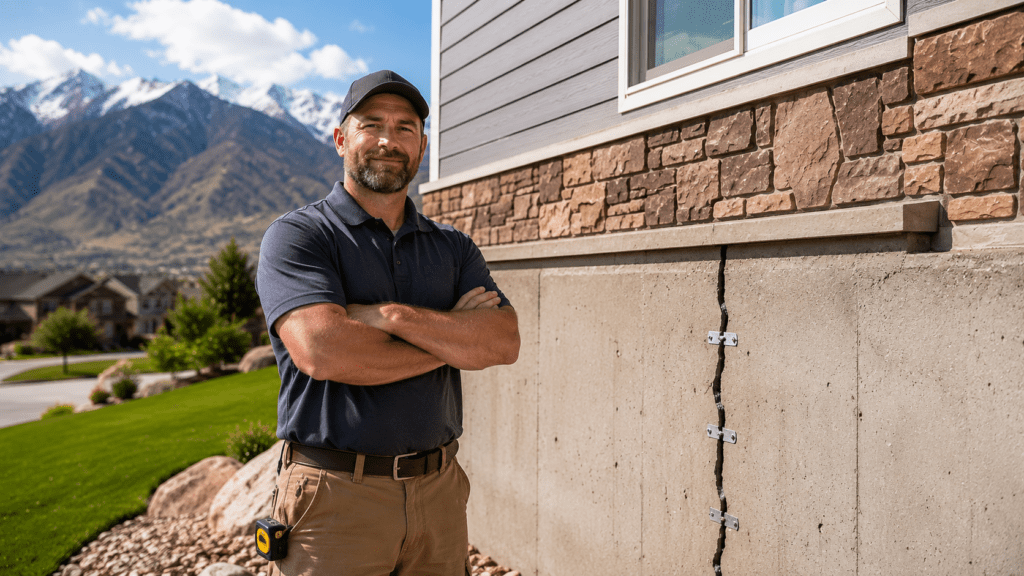
Running a foundation repair company across Utah, from the northern Wasatch Front to southern St. George, has taught us what works and what doesn’t.
What Actually Prevents Problems
The homes we see with the fewest settlement issues share common traits: proper drainage management installed during construction or added during renovation, correctly functioning gutters, grading that slopes away from the house, and regular maintenance.
Common Mistakes We See
- Downspouts that terminate right at the foundation
- Landscaping that slopes toward the house
- Deferred maintenance on gutters
- Dismissing early warning signs
- Delaying inspections when concerned
When Homeowners Regret Waiting
We often hear, “I noticed that crack three years ago, but it seemed minor.” By the time they call, the minor settlement has worsened. What might have been managed with drainage improvements now requires piering. The cost difference is substantial.
Your Action Plan: Decision Framework
Use this framework to decide what to do:
If You Notice Hairline Cracks (Smaller Than 1/8 Inch)
- Action: Monitor. Take a photo with a date stamp. Check again monthly. If stable after 3-6 months, no action needed. If growing, call.
- Cost to You: Zero. Just attention.
If You Notice Diagonal Cracks Wider Than 1/4 Inch
- Action: Call for a free inspection. This isn’t an emergency requiring you to panic, but it warrants professional eyes.
- Cost to You: Free inspection. If needed, we’ll discuss solutions with you.
If You Notice Horizontal Cracks, Bowing Walls, or Water Seepage
- Action: Call sooner rather than later. These indicate active water pressure or structural stress.
- Cost to You: Free inspection. These usually indicate more serious problems that cost more if delayed.
If you notice doors sticking, floors sloping, or multiple issues together
- Action: Definitely call. Multiple indicators suggest active differential settlement.
- Cost to You: Free inspection to determine scope.
Why You Should Get an Inspection Even If You’re Unsure
Here’s the reality: You don’t have to be 100% certain something is wrong to call. We give free inspections because
- We can diagnose in minutes - What takes you weeks of worry, we assess in 30-45 minutes.
- Early detection saves money - The difference between addressing settlement early vs. waiting years can be $5,000-$10,000 or more.
- You’ll actually know - Instead of wondering and worrying, you’ll have a professional assessment and recommendations.
- No obligation - A free inspection doesn’t obligate you to anything. You’ll just know where you stand.
We’ve done this thousands of times across Utah. We’ve seen homes with cosmetic cracks and homes with subtle signs of serious problems. We know the difference.
The Bottom Line
Foundation settlement is normal. Differential settlement, which can cause cracks, sticking doors, uneven floors, or water problems, requires attention.
In Utah, our climate and soils make differential settlement particularly common. But it’s also preventable and manageable if you address it thoughtfully.
Don’t panic about every crack. But don’t ignore clusters of signs either. When in doubt—especially if you notice multiple indicators such as sticking doors, uneven floors, or visible cracks—call for a free inspection.
We’ve helped thousands of Utah homeowners understand their foundation’s actual condition. Most find that early attention costs less and provides greater peace of mind than years of uncertainty.
If you’re seeing signs of foundation settlement or just want professional confirmation that everything’s fine, give us a call. That’s what we’re here for.
Frequently Asked Questions
Is all foundation settling a problem?
No. Uniform settling (the entire foundation sinking evenly) is normal and expected. Differential settling (uneven sinking) is what causes problems. The trick is determining which you have.
Will my foundation eventually stop settling?
In most cases, yes. Significant settling usually occurs in the first 5-10 years. After that, settlement typically becomes minimal unless drainage or soil conditions change dramatically.
Can I fix foundation settlement myself?
Minor prevention (gutters, grading, drainage), you can manage. But structural solutions like slab jacking or piering require professional equipment and expertise. Attempting DIY fixes often makes problems worse.
How much does foundation repair cost in Utah?
It depends entirely on the problem. A drainage solution might cost $2,000 to $5,000. Slab jacking might run $3,000 to $8,000. Piering systems can be $10,000-$20,000+. The only way to know is with a free inspection and quote.
Should I get a second opinion?
If you’re uncertain or the recommended solution seems extensive, absolutely. Get another inspection. We welcome the comparison. Most of the time, proper diagnosis points to similar solutions anyway.
Does foundation insurance exist?
Most homeowner’s insurance doesn’t cover foundation settlement (they consider it a maintenance issue). Some specialized policies exist, but they’re rare and expensive. Prevention and early action are your best protection.
Is selling a home with foundation problems possible?
Yes, but Utah requires disclosure of known foundation issues. Homes with disclosed problems sell for less and with more difficulty. Early repair is usually worth it for resale value.
How often should I inspect my foundation?
Annually is reasonable. Quarterly, during spring and summer, is ideal if you’re concerned. At a minimum, inspect after heavy snowmelt and during summer drought.
Ready to Know Your Foundation’s Real Status?
Stop wondering. Stop worrying. Get answers.
We offer free foundation inspections across Utah. We’ll identify what’s normal, what needs monitoring, and what needs action. No pressure. No sales pitch. Just honest assessments from people who’ve been doing this for years.
Call us for your free inspection: 801-509-5344.
Or fill out our online form for a callback at your convenience.
Because your home deserves to be sound. And you deserve to know where it actually stands
Rhino Foundation Systems has been providing foundation repair, slab jacking, and drainage solutions throughout Utah for 40 years. We specialize in the unique challenges of Utah’s clay soils and climate, and we’ve helped thousands of homeowners make informed decisions about their foundations.