
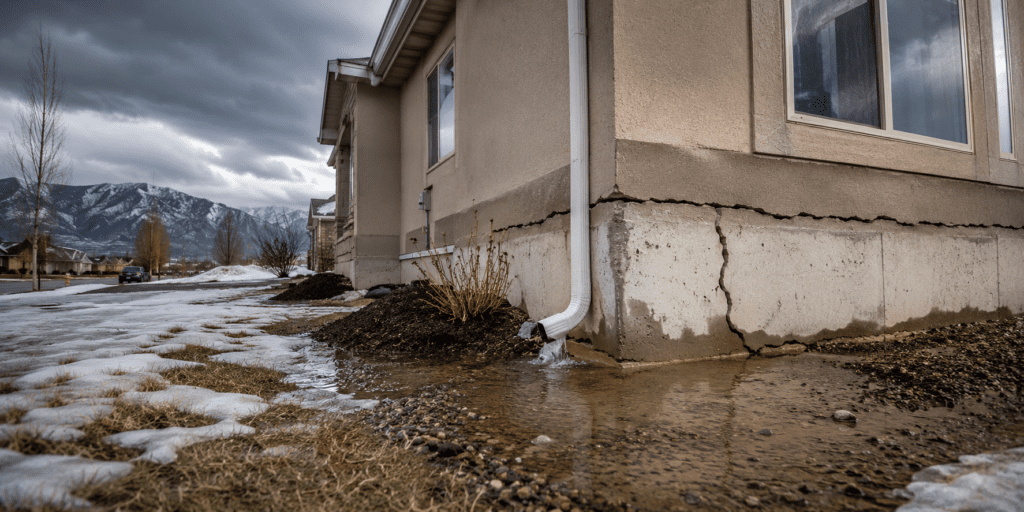
Over 30 years repairing foundations across Utah—from the clay-heavy Wasatch Front to the varying soils of the Uinta Basin—I’ve learned one thing: most property owners blame concrete when they should be blaming water.
Concrete doesn’t settle because it’s weak. It settles because of what’s underneath the concrete, and more specifically, what water does to the soil supporting it.
Here’s what surprised me early in my career: Utah’s water problems look different than other regions. We don’t have the relentless rainfall of the Pacific Northwest or the consistently high water tables of the Midwest. Instead, we have something trickier—seasonal extremes. Snowmelt in spring can cause sudden saturation. Summer heat and low humidity create shrinkage cycles. Irrigation systems oversaturate soil around foundations. And in some areas, capillary rise from deeper water tables silently undermines bearing capacity year-round.
I’ve seen settlements caused by piping near the downspout discharge. I’ve seen uniform settling from soil saturation that happened invisibly, with no surface water ever visible. And I’ve seen homes cycle through wet-season swelling and dry-season shrinkage, accumulating damage with each cycle until the concrete can’t withstand another cycle of movement.
The property owners I’ve worked with share a common trait: they missed the early warning signs. Not because those signs were subtle, but because they didn’t know what to look for. They assumed cracks were cosmetic. They thought slow movement was stable. They installed drainage systems that looked right but didn’t actually solve the problem.
This guide presents field observations on the mechanisms of water-induced settlement, the patterns observed in Utah foundations, and the early warning signs that distinguish a manageable issue (Year 2-3) from a costly repair (Year 5+).
How Water Actually Causes Concrete Settlement: The Three Primary Mechanisms
Concrete settlement from water follows three overlapping patterns, each with different warning signs and progression rates.
1. Subsurface Erosion and Piping
What happens:
Water flowing through soil creates pathways, removing fine soil particles and leaving behind voids. This process, called piping or subsurface erosion, works like this:
- Water finds the path of least resistance through soil.
- It carries fine particles (clay, silt, sand) along with it.
- These particles move away from the foundation perimeter.
- Larger particles remain, but the matrix holding them weakens.
- Support capacity directly under the foundation decreases.
- The foundation settles into the newly created void space.
In Utah, I see this most often near downspout discharge areas. A downspout that discharges 3 feet from the foundation creates a concentrated water channel. Over time, it erodes the soil directly beneath the footing. I’ve done excavations where the void space under a foundation was visible—sometimes 2-3 inches of vertical settlement already in progress.
Another common pattern: properties with perimeter drains that were never cleared or properly sloped. The drain becomes a water-filled channel that delivers water closer to the footing rather than away from it. I’ve found French drains running toward foundations instead of away from them.
Why property owners miss it:
Piping happens underground. You can’t see it. The only evidence is the settlement itself—the cracked concrete, the sticking door, the widening gap where the house pulls away from the porch.
By the time settlement becomes visible, piping has often been active for months or years. In Utah’s climate, you might not notice this during a dry summer. It becomes apparent in spring, when the snowmelt suddenly stresses a weakened footing.
Field indicators:
- Settled concrete in isolated areas (not uniform across the foundation)
- Boiling or soft spots in the yard during heavy rain or snow melt.
- Water tracking at unusual angles under the foundation
- Differential settlement (one corner drops while others stay level)
- Concentrated settling near drainage discharge points (downspouts, drain line outlets)
Piping accelerates near drainage transitions—where downspout discharge meets foundation perimeter, where surface water routes alongside the footing, and where interior drainage systems leak. In Utah, I’ve also seen it accelerate, with irrigation systems running parallel to foundations, creating constant, if mild, saturation throughout the growing season.
2. Soil Saturation and Loss of Bearing Capacity
What happens:
When soil becomes saturated, it loses the friction and particle-to-particle contact that provide bearing capacity. The process is straightforward:
- Dry soil particles lock together through friction.
- Water fills the pore space between particles.
- This water layer creates separation between particles.
- The weight that soil can support drops dramatically
- The foundation settles until it reaches soil that can re-establish bearing capacity.
This is why saturated clay soils are particularly problematic. Clay particles are very small and closely packed. When water fills the spaces between them, the soil loses much of its shear strength, which is its resistance to sliding or shifting
Why this matters in Utah specifically:
Utah’s Front Range soils—those in Salt Lake, Utah, and Davis counties—have significant clay content. Often, 30-50% of the upper soil profile is clay. This is good for bearing capacity when dry. It’s terrible when saturated. A clay soil that supports 3,000 pounds per square foot when dry might only support 1,000 pounds when saturated. I’ve measured this with engineering borings.
The Wasatch Front also has seasonal water table fluctuations that other regions don’t experience as dramatically. Spring snowmelt can raise the water table by 2-4 feet in a matter of weeks. Properties with footings at 4 feet might suddenly have saturated bearing soils. By mid-summer, the water table drops again, but the damage to bearing capacity has already accumulated.
Saturation severity depends on:
- Soil type (clay loses more capacity than sandy soils)—Utah’s clay soils lose capacity aggressively.
- Depth of water table (Utah’s water table varies seasonally, creating cycling stress)
- Duration of saturation
- Quality of site drainage
- Foundation depth relative to groundwater
Property owners typically miss this because:
The foundation doesn’t suddenly collapse. Instead, it slowly sinks as the bearing capacity gradually decreases. A 10-foot footing can settle 1/8 inch per year over eight years, causing 1 inch of total settlement. That much movement is enough for significant cracking but occurs slowly, making the change feel gradual rather than alarming.
In Utah, this is especially easy to miss because settling occurs mainly in spring and early summer, when snowmelt saturates soils. During the dry summer and fall, there’s no new movement. Owners see that the crack has been stable for six months and assume the problem has stopped. What they’re not seeing is that the bearing capacity is recovering only slightly—the damage is cumulative.
What to watch for:
- Consistent, uniform settlement across a foundation (not isolated)
- Gradual cracking that worsens slowly year after year
- Settlement following wet seasons or after heavy rainfall periods
- In Utah specifically, new cracks or widening cracks in spring (April-June), and stalling in late summer
- The foundation is moving downward rather than shifting laterally.
3. Expansive Soil Movement and Cycle-Induced Settlement
What happens:
Some soils swell when wet and shrink when dry. This isn’t uniform. Expansion pressures create movement. Over many cycles, this results in net settlement.
How the cycle works: Wet season: Soil swells and pushes the foundation up slightly. Dry season: Soil shrinks, and the foundation settles.
The key problem: The foundation doesn’t return to its original level. Somewhere along the cycle—often at the transition points—differential settlement accumulates. Rebar loses contact with concrete. Small cracks form. Each cycle propagates damage slightly further.
Utah-specific insight:
While Utah isn’t known for the extremely expansive soils of Texas or Colorado, we have pockets of problematic soils. More importantly, we have dramatic seasonal swings that trigger cycling in marginally expansive clays.
A foundation in the Wasatch Front experiences:
- April-May: Snow melt saturation (soil swells)
- June-September: Rapid drying from heat and low humidity (soil shrinks dramatically)
- October-March: Moderate moisture (relative stability)
This isn’t a 2-season cycle. It’s a violent spring expansion followed by a rapid summer contraction. I’ve measured 1/4 to 1/2 inch of vertical movement in a single season on some properties with marginally expansive soils.
What makes this especially damaging: The transition points between wet and dry are when most movement accumulates. The rebar hasn’t accommodated the new position when the next cycle begins. After 10-20 cycles, the concrete develops microcracks at rebar interfaces, and a single crack can then propagate.
This is especially common in:
- Expansive clay regions (parts of Texas, Oklahoma, Colorado, Southwest)—Utah’s Front Range qualifies
- Properties with poor surface drainage—very common in Utah, where landscape irrigation is heavy
- Crawl spaces with inadequate ventilation—common in older Utah homes
- Areas with seasonal water table fluctuations—this is Utah’s defining characteristic.
Why does this deceive property owners:
The cracking seems to happen during wet seasons. Owners assume it’s just seasonal movement. They expect it to heal when things dry out. But the damage from swelling and shrinking accumulates. Eventually, the concrete can’t accommodate another cycle and fails.
In Utah specifically, I’ve had owners tell me: “I noticed the crack in May, but it closed up in August, so I didn’t worry about it.” The crack didn’t close—it stayed open. What changed was the pressure driving visible new cracking. The previous cracks are still there, still compromised.
The Mechanics: Why Water Undermines Soil Support
Understanding why water causes settlement requires understanding how soil stays solid.
Effective Stress and Pore Pressure
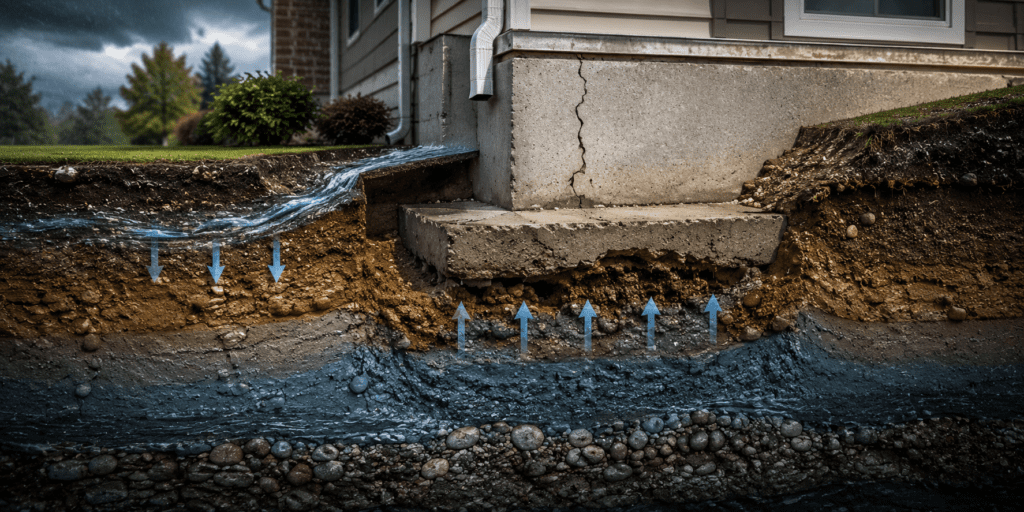
Soil stability depends on a concept called effective stress—the real pressure between soil particles that prevents movement.
Effective stress = Total stress – Pore water pressure
Dry soil: Water occupies maybe 20% of the pore space. Soil particles contact each other directly. Friction is high.
Saturated soil: Water fills 100% of the pore space. Soil particles are separated by water. The water itself is incompressible, but it exerts equal pressure in all directions (this is hydrostatic pressure). Friction between particles drops dramatically.
In practical terms, A clay soil that can safely support 3,000 pounds per square foot when dry might only support 1,000 pounds per square foot when saturated. The concrete doesn’t get lighter—the soil gets weaker.
Capillary Rise and Hidden Saturation
This is what property owners miss most consistently. And in Utah, it’s a bigger problem than most realize.
You don’t need standing water to saturate soil. Capillary action pulls water up through fine-grained soils (clay and silt) from the water table below, even if you never see surface water.
Typical capillary rise distances:
- Clay: 3 to 10 feet
- Silt: 1 to 3 feet
- Sand: 0.3 to 1 foot
- Gravel: essentially zero
Here’s what matters for Utah specifically:
A property with a water table 6 feet down might have moisture-saturated soil at 2 feet below grade—right where foundation footings sit. And the property owner sees nothing. No pooling water. No wet basement. Just slow, invisible saturation working against the bearing capacity.
I’ve done borings on properties throughout Utah that showed water tables deeper than most owners expected—sometimes 8-12 feet down. But capillary rise was still pulling moisture up to 4-5 feet, right into the upper foundation bearing zone. The owner’s basement was dry (no water pooling), but the soil supporting the foundation was chronically damp.
In spring, when the water table rises with snow melt, the capillary moisture zone moves up even further. A property that had a water table at 8 feet in August might have one at 5 feet in May. The capillary rise zone just shifted higher—right into the footing.
Why this matters:
The saturation is there. The bearing capacity reduction is there. The settlement is happening. But the property owner can walk their yard in the middle of summer and see nothing—no puddles, no boiling soil, nothing. Then they’re surprised when their foundation starts to settle.
I’ve also seen cases where basements stay dry because the foundation is well sealed or because sump systems pump out water. Owners assume “no water = no problem.” But the soil around the foundation is still saturated from capillary rise, still losing bearing capacity, still causing settlement.
The saturation is doing its job. The sump pump is just keeping the basement dry while the foundation slowly sinks.
What Property Owners Consistently Miss: The Early Signs
1. Slow Cracking That Seems “Stable.”
The mistake: “The crack has been there for three years without changing. It must be fine.”
Reality: Settlement cracks often grow slowly. A crack that’s unchanged for 36 months might double in width over the next 18 months if the underlying water problem isn’t addressed. Slow doesn’t mean stable—it means the loading process is slow, not that it’s stopping.
2. Drainage Systems That “Work.”
Property owners see rain running down the gutters and through the downspouts and assume everything is fine.
What they’re missing:
- Downspout discharge might be redirected away from the foundation, but it still creates a water channel toward the footing.
- Gutters might overflow on one side, saturating soil in ways that go unnoticed.
- French drains might be clogged or improperly sloped.
- Sump pump systems might only activate during extreme events, leaving moderate moisture problems unaddressed.
The distinction that matters: Water management that prevents pooling on the surface ≠ , and water management that prevents soil saturation. You need both.
3. Settling That Seems Isolated
“Only one corner is cracking. The other sides are fine.”
What this actually means: That corner is experiencing concentrated loading, or that specific area has worse drainage or a deeper water table. It’s not random. It’s not something to ignore.
Differential settlement is more damaging than uniform settlement because it creates shear stresses within the concrete. The concrete can’t accommodate uneven movement without cracking.
4. The “Seasonal” Crack Assumption
“These cracks show up every spring and close in summer.”
The cracks aren’t opening and closing—they’re remaining open. What changes seasonally is the pressure driving settlement. The cracks accumulate.
How to Identify Water-Caused Settlement vs. Other Causes
The diagnosis determines the fix. Get it wrong, and you’ll waste money and time.
Settlement Patterns That Point to Water
| Settlement Pattern | Likely Cause | What to Check |
|---|---|---|
| Differential (one area lower than others) | Localized piping, concentrated drainage failure | Drainage around that area; soil type variations |
| Uniform across entire foundation | General soil saturation, high water table | Grading, perimeter drainage, water table depth |
| Progressive (gets worse in wet seasons) | Seasonal saturation, expansive soils | Seasonal water table fluctuations, soil type |
| Concentrated near drainage discharge | Piping from downspout or drain line | Downspout routing, drain line integrity |
Settlement Patterns That Point to Other Issues
- Foundation design inadequacy (footing too shallow, too small): Usually shows immediately after construction
- Structural overload (roof addition, second story): Settlement is proportional to the added load
- Expansive soils without water trigger (rare but possible): Consistent movement even during dry periods
- Poor concrete quality or construction (improper curing, reinforcement issues): Usually apparent within 1-2 years post-construction
The Water-Settlement Timeline: What Happens and When
Year 1: Piping begins or soil saturation increases. No visible settlement yet. Maybe subtle drainage issues become apparent.
Years 2-3: Settlement reaches 1/4 to 1/2 inch. Cracks begin. They’re narrow (hairline or 1/8 inch). The property owner might notice, but often doesn’t take action—cracks seem minor.
Years 4-6: Settlement reaches 1/2 to 1.5 inches. Cracks widen to 1/8 to 1/4 inch. Now doors and windows are sticking. Gaps open between the foundation and the structure. Boiling or soft soil appears in the yard during heavy rain.
Years 6+: Settlement exceeds 1.5 inches. Structural damage becomes serious. Cracks are 1/4 inch or wider. Failure risk increases significantly.
The critical intervention window: Years 1-3, when settlement is just starting, and damage is minimal. By year 4, you’re managing an emergency rather than preventing one.
Common Mistakes That Accelerate Water-Induced Settlement
These are the patterns I see repeatedly in Utah foundation failures. They’re not accidents—they’re the result of incomplete understanding or short-term thinking.
Mistake #1: Installing Drainage Systems Without Verification
What this looks like: A contractor installs a French drain around the foundation, the property owner pays the bill, and they both assume the problem is solved.
Why it fails: I’ve excavated properties with “installed” drainage systems that were:
- Sloped toward the foundation instead of away (concrete pad sloped the wrong direction)
- Terminating in low spots instead of daylight (drain pipe ends in a gravel-filled hole that becomes a reservoir)
- Buried so shallow they’re above the footing level (not intercepting the water that matters)
- Silted in or clogged within a few years (not maintained)
I found one property where the French drain was installed on the uphill side of the foundation. It was literally directing water toward the footing. The owners had spent $8,000 on the system and another $12,000 on foundation repair before anyone verified the drain was actually working.
Right approach: Confirm the drain has adequate slope (typically 1% minimum, which is 1 foot of drop per 100 feet of run—easier said than done on level Utah terrain). Verify it reaches a proper outlet (daylight, sump, municipal system). Check that it’s actually clear (not silted in). I recommend having it jetted out every 5-7 years in areas with heavy clay soils.
Mistake #2: Only Addressing Surface Drainage
What this looks like: Installing gutters and downspouts, grading away from the foundation, and assuming the problem is solved.
Why it fails: I see this constantly in Utah. A property owner fixes their surface water routing—gutters are clean, downspouts discharge away, grading is correct—and they expect the settling to stop.
But subsurface water (capillary rise, groundwater, soil saturation from snow melt) is often the primary driver. I tested a property in Salt Lake County where the gutters and grading were perfect. No surface water anywhere. But the foundation had settled over 2 inches over 15 years because the soil was chronically saturated from capillary rise.
Right approach: Surface and subsurface management—gutters, grading, perimeter drains, sump systems, moisture barriers, and capillary breaks. They work together. Any one of them alone is incomplete.
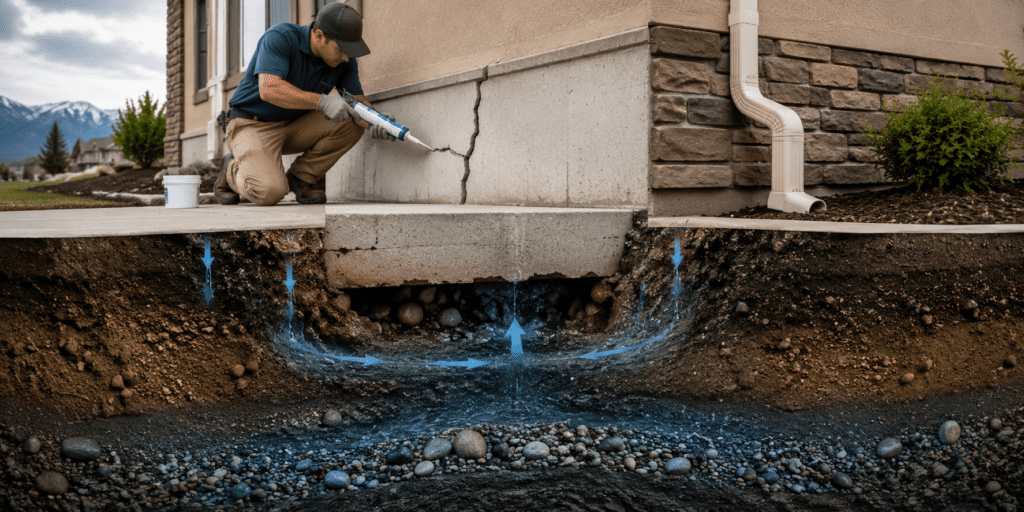
Mistake #3: Assuming Cracks Are Cosmetic
What this looks like: Caulking cracks and painting over them.
Why it fails: This is everywhere in Utah. Owners see a hairline crack, assume it’s cosmetic, caulk it with concrete sealant, and think they’re done.
The crack is a symptom, not the problem. Caulking doesn’t stop settlement. As settlement continues (and it will if the water problem isn’t solved), the crack re-opens or grows past the caulk. Now you’re re-caulking every two years.
I had a client who’d been caulking the same crack for 12 years. They’d refilled it probably 20 times. The crack had grown from 1/8 inch to 1/2 inch. When I excavated, the foundation had settled almost 2 inches at that corner. The caulk had just been hiding the problem, not solving it.
Right approach: Identify the cause of the settlement, address the water management failure, and then address the resulting cracks. Don’t waste time or money on cosmetic solutions while the foundation is still moving.
Mistake #4: Landscape Irrigation That Oversaturates
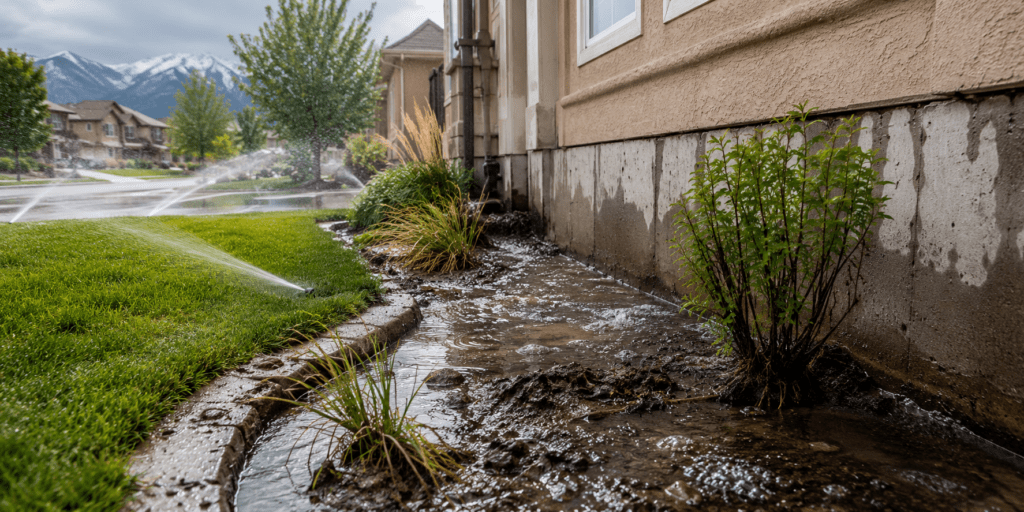
What this looks like: Automated sprinkler systems that run daily during the growing season, soaking the soil along the foundation perimeter.
Why it fails: This is especially problematic in Utah, where irrigation is common, and water is (relatively) affordable. A foundation perimeter that’s intentionally kept dry might get saturated daily from July to September by an irrigation system designed for the lawn, not the foundation.
I documented a case in South Jordan where the landscape sprinklers ran on a 24-hour cycle directly adjacent to the foundation. That foundation had settled 1.5 inches over eight years. When the irrigation zone was moved away from the perimeter, settlement essentially stopped.
Right approach: Zone irrigation away from building perimeters. If you’re going to water landscaping close to the house, do it infrequently and deeply (less frequent watering, more water per cycle), so the soil has time to dry between cycles rather than remaining chronically moist.
Mistake #5: Installing a Sump Without Ensuring It Captures Water
What this looks like: Installing a basement sump pump that activates only during extreme events (major flooding).
Why it fails: Settlement often happens from chronic moderate saturation, not acute flooding. A sump that sits dry 99% of the time isn’t managing your primary water problem.
In Utah’s clay soils, capillary rise is continuous. A sump system that activates only during floods ignores the everyday saturation that’s happening.
Right approach: Ensure the sump system is integrated with perimeter drainage and interior collection systems. It should activate regularly during damp conditions, not just floods. In clay-heavy areas (which include most of Utah), a sump pump that never activates is a sign that the perimeter drainage is inadequate.
Mistake #6: Delaying Action Because Movement Seems Slow
What this looks like: “The crack grew 1/8 inch in three years. It’s fine.”
Why it fails: Settlement is often logarithmic in its early stages—slow at first, then accelerating. That 1/8 inch over three years might become 1/4 inch over the next 18 months.
I also see seasonal acceleration in Utah. A foundation might be stable from June to March, then crack rapidly in April and May during snow melt saturation. Owners see the summer stability and assume the problem has stopped. It hasn’t—it’s just waiting for the seasonal water pressure to return.
Right approach: Any settlement should trigger an investigation. Early intervention (Year 1-3) prevents exponential damage. By Year 5, you’re managing an emergency, not preventing one.
What Most Contractors Get Wrong About This Problem
I include myself in this criticism. When I started doing foundation repair in Utah, I missed things.
Over-Reliance on Cosmetic Fixes
Many contractors (including ones I’ve worked with) recommend:
- Epoxy crack injection
- Polyurethane sealants
- Carbon fiber straps
- Helical piers without addressing water
These might be necessary eventually, but they’re not solutions if water is still compromising bearing capacity. You’re patching the symptom while the root cause continues to progress.
I’ve seen helical piers installed on properties with inadequate drainage. The piers stabilize the foundation, but the soil around them is still saturated. The settlement might stop, but you’re in a precarious equilibrium. The next wet year puts pressure back on.
Inadequate Site Investigation
Proper diagnosis requires:
- Water table assessment (boring or permeability tests)
- Soil classification (grain size, clay content, plasticity)
- Drainage evaluation (surface and subsurface)
- Foundation depth and footing condition assessment
- Groundwater movement patterns
Many contractors (even experienced ones) skip this and recommend solutions based on what they usually sell rather than what your specific property needs.
I learned this the hard way. I had a property where I recommended a full perimeter drain system. The boring later showed the water table was 12 feet down—capillary rise was the issue, not active groundwater flow. I’d recommended an expensive solution to the wrong problem.
Now, I always get the boring first. It costs $500-$800 and saves thousands in wasted effort.
Underestimating Capillary Rise and Seasonal Fluctuation
Contractors sometimes assume “dry basement = no water problem.”
In Utah’s clay soils, this is backward. Basements stay dry because they’re sealed or because you’re pumping water out. The saturation is still there, affecting bearing capacity. I’ve seen basements that were perfectly dry, with foundations settling by 2+ inches, because the capillary-saturated bearing soils had lost their capacity to retain water.
I also see contractors underestimate Utah’s seasonal fluctuations in the water table. A contractor from a region with stable water tables might assume Utah’s water table is at a fixed depth. In reality, the water table in the Wasatch Front can swing 4-6 feet from summer to spring. This creates cycling stress that, over the years, accumulates settlement.
Missing Utah-Specific Soil Behavior
Utah’s soils vary dramatically by region and even by neighborhood. I work in areas with:
- Pure clay (Wasatch Front residential areas) that loses 60%+ bearing capacity when saturated
- Sandy clay has lower expansion potential but remains problematic when wet.
- Silts and sandy soils with less clay content, but often worse drainage due to soil structure
Contractors unfamiliar with Utah soils might apply solutions from other regions that don’t work here. A solution that works perfectly in Colorado’s expansive clays might be incomplete for Utah’s clay-silt mixtures.
Proper Water Management for Settlement Prevention: Utah-Specific Strategies
These recommendations are based on 15 years of work on Utah foundations. They’re not generic—they’re specific to Utah’s climate, soils, and seasonal patterns.
Foundation-Level Strategies
1. Perimeter Drainage System
Install a continuous drain around the foundation footing level, sloped to discharge away from the building. This intercepts groundwater and subsurface water before it reaches the footing.
Utah-specific considerations:
- In Utah’s clay soils, you want the drain at or slightly below the footing level. Anywhere above that and you’re missing the capillary saturation zone.
- Slope is critical on Utah’s relatively flat lots. I recommend a minimum slope of 1.5% (which is often difficult on level properties). Some properties require a sump system because daylight drainage isn’t feasible.
- The drain outlet matters. “Draining to daylight” sounds good in theory. In practice, I’ve seen daylight outlets that terminate at the neighbor’s property line or in a wash that becomes a seasonal water source. Consider drainage to a sump system instead, where you have control over the discharge.
- French drains work in Utah, but they can silt in within 5-7 years in clay-heavy areas. They require jetting maintenance periodically.
Cost in Utah: $7,000–$15,000, depending on foundation size and accessibility. More if a sump system is required.
2. Interior Drainage and Sump Systems
In basements or crawl spaces, interior collection around the perimeter prevents water from reaching the foundation.
Utah-specific setup:
- Perimeter perforated pipe at floor/footing level
- The interior footer drain is collecting water.
- Sump pit with properly sized pump (1/2 HP for most residential, 3/4 HP for clay-heavy soils)
- Regular discharge (minimum 10 feet away, ideally into a storm drain or drainage system)
- Backup power or battery backup (Utah can have power outages during heavy spring storms, when the sump is most critical)
In Utah’s seasonal saturation pattern, I recommend that interior sumps use a timer that activates during spring (April-June), even if no water has accumulated. If the sump activates, water is captured. If it never activates, your perimeter drain is either oversized or your drainage system is adequate.
Cost in Utah: $3,000–$6,000 for a properly installed interior system.
3. Capillary Barriers
This is underutilized in Utah and should be standard.
In the case of high water tables or chronic capillary saturation, a capillary break (polyethylene sheeting or rigid foam board) under slabs and in crawl spaces prevents capillary rise from reaching the structure above.
If you have a basement, rigid foam insulation under the basement floor (above the footing, extending horizontally) blocks capillary rise and reduces bearing pressure.
In crawl spaces, a continuous vapor barrier (6-mil polyethylene) prevents moisture from rising into the structural system above.
Cost in Utah: $2,000–$8,000, depending on foundation size and whether you’re doing new construction (cheaper) or retrofitting (more expensive).
4. Moisture Control in Crawl Spaces
For crawl space properties (very common in Utah), vapor barriers and dehumidification prevent moisture from the ground while keeping the space accessible for maintenance.
Standard practice:
- 6 mil polyethylene vapor barrier over soil
- Perimeter foundation vents closed (counterintuitive but correct—unsealed vents let in humid spring air)
- Dehumidifier running from March to June, when natural moisture is highest.
- Perimeter drain if groundwater is present
I’ve seen this reduce crawl-space humidity from 80%+ to 50-60%, significantly slowing settlement progression in clay soils.
Cost in Utah: $3,000–$8,000 for a properly sealed system with dehumidification.
Site-Level Strategies
1. Grade Management
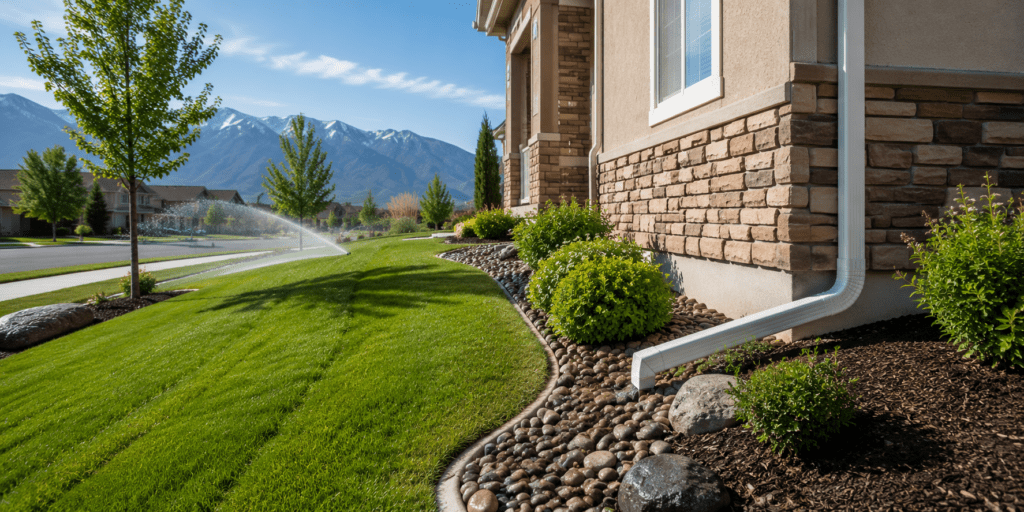
Slope the ground away from the foundation—typically 6 inches of drop over 10 feet. This prevents surface water from pooling against the building and reduces infiltration into the soil near the foundation.
In Utah, this is often the easiest fix for surface water problems. Many properties have developed low spots near the foundation due to settlement. Regrading can redirect that water.
Cost in Utah: $800–$3,000 for most residential properties.
2. Roof Discharge Management
Gutters and downspouts must discharge water away from the foundation, not just away from the building. A downspout that discharges 4 feet away is creating a saturated zone around the footing.
Utah-specific insight: Many properties have downspout extensions that are removed or poorly maintained. I recommend:
- Gutter systems that are actually maintained (cleared of debris at least twice yearly—spring and fall)
- Downspout extensions that discharge at least 10 feet away
- Or downspouts directed into drainage systems that discharge to proper outlets
- NOT into landscape beds that are adjacent to the foundation (these become reservoirs)
Cost in Utah: $500–$2,000 for gutter maintenance and extension upgrades.
3. Landscape Irrigation Management
Automated irrigation systems often oversaturate soil near foundations. In Utah’s arid climate, irrigation is common, and I see a lot of foundation saturation from sprinkler systems.
Recommendations:
- Zone irrigation away from the building perimeter (minimum 5 feet)
- If you’re going to irrigate close to the house, use drip irrigation with less frequent cycles (deep but infrequent watering)
- Program irrigation systems to run early morning (water has time to percolate before the heat evaporates it)
- Turn off irrigation in mid- to late summer if rain occurs.
Cost in Utah: $0 (if you’re modifying existing systems) to $3,000–$8,000 for redesigning irrigation zones.
4. Impermeable Surfaces
Hardscape (concrete, asphalt) near the foundation can prevent water infiltration, but it must slope properly. Improper pooling is worse than no surface at all.
In Utah, I see a lot of patios and driveways that pond water against the house. Before you pour concrete near a foundation, ensure:
- Adequate slope away from the building (4% minimum, which is 1/2 inch per foot)
- A drain system if daylight slope isn’t possible
- NOT sloped toward the house under any circumstances
Cost in Utah: Varies, but correcting a poorly sloped surface is expensive (removal and replacement). Get the slope right the first time.
When Professional Repair Becomes Necessary
If water management hasn’t stopped settlement, structural repair becomes necessary.
Foundation Lifting and Re-leveling
When appropriate: Settlement is 1 to 3 inches, structure is salvageable, but bearing capacity must be restored.
Typical methods:
- Helical piers (screw-in steel shafts reaching stable bearing strata)
- Micropiles (small-diameter drilled piers with grout)
- Mudjacking or polyurethane injection (lifting concrete by injecting material underneath)
Critical requirement: The water problem must be solved first or simultaneously. Otherwise, the repair settles again within a few years.
Concrete Repair
Once settling has been stopped, cracks in concrete usually need attention:
- Hairline or narrow cracks (< 1/8 inch): Typically cosmetic, sealant-level repair
- Wider cracks (1/8 to 1/4 inch): Usually warrant epoxy or polyurethane injection
- Cracks with movement: Might need reinforcement (carbon fiber) or structural repair
Red Flags That Demand Immediate Investigation
Call a professional if you observe any of these:
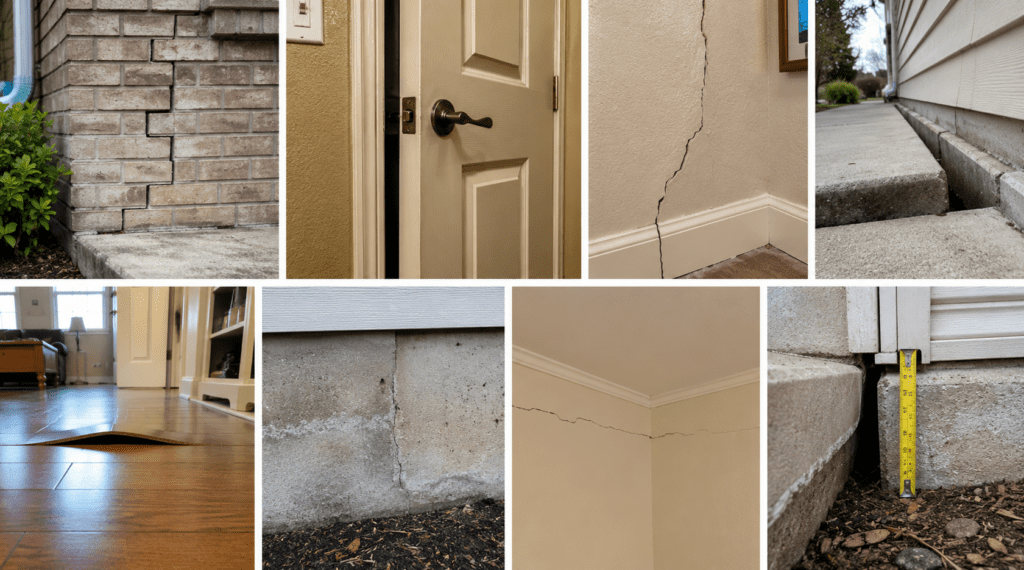
- New cracking in concrete or masonry (exterior or interior)
- Doors or windows sticking or failing to close properly (especially if this is recent)
- Gaps are opening between the foundation and structure (where walls pull away from the concrete)
- Boiling or soft soil in the yard during or after rain
- Visible water pooling against the foundation (even temporarily)
- Stair-step cracking in brick masonry (diagonal pattern across mortar joints)
- Cracks that are visibly growing (mark with tape and photograph; if it crosses the mark in 30 days, it’s active)
- Foundation moving noticeably (one side of a structure is clearly lower than the other)
- Water seeping into the basement or crawl space (even small amounts signal saturation)
What Property Owners Can Do Right Now
If you’re concerned about water and settlement but aren’t ready for professional repair:
Immediate Actions (This Week)
- Walk your entire foundation perimeter after the next rain. Look for:
- Water pooling or standing
- Soft ground (squeeze soil—if water comes out, it’s saturated)
- Boiling or movement in soil
- Discharge from downspouts and drainage
- Inspect your gutters and downspouts:
- Are they clear of debris?
- Do they discharge at least 6 feet away from the foundation?
- Better yet, 10+ feet or into a drain system?
- Check your grading:
- From the foundation outward, does the ground slope away?
- Are there valleys or low spots that cause water to pool against the building?
- Photograph any cracks:
- Mark their location, width, and length.
- Date the photo
- Photograph again in 30 days.
- If cracks have widened or new ones appeared, document it.
Short-Term Actions (This Month)
- Install or clean gutters if necessary.
- Extend the downspout discharge away from the foundation.
- Correct grading if water is pooling
- Clear debris from any existing drainage systems
- Get a professional evaluation if you’ve identified water management issues.
Professional Assessment
If you can’t rule out a water problem, have a foundation professional assess:
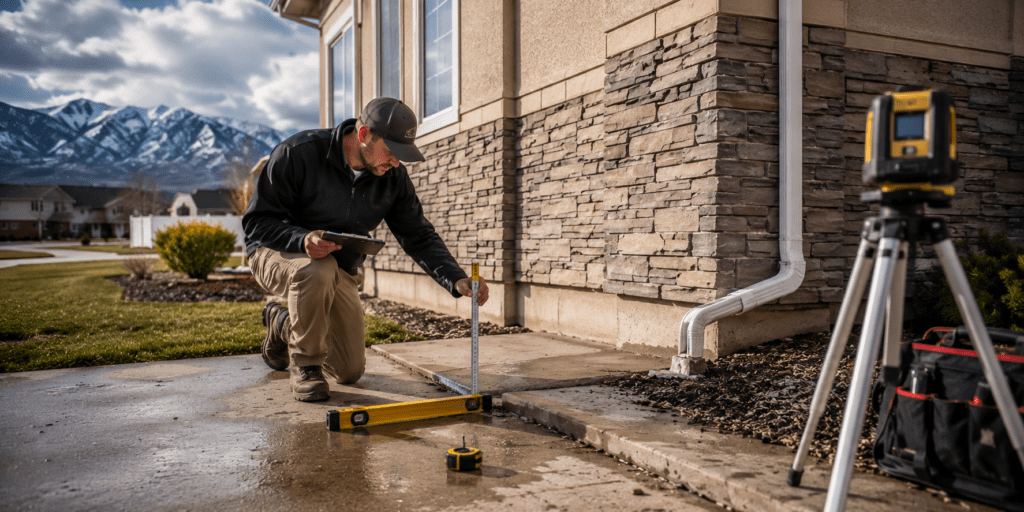
- Current settlement (laser level or traditional methods)
- Water table depth (simple boring or observation well)
- Drainage system condition (visual inspection)
- Foundation footing condition (exploratory excavation if needed)
- Soil conditions (boring samples analyzed)
This assessment costs $500–$2,000 but clarifies whether you’re dealing with a minor drainage issue or an active foundation settlement requiring repair.
The Long-Term View: Prevention Is Cheaper Than Repair
Cost of water management: $5,000–$25,000 (gutters, grading, drainage systems)
Cost of foundation repair after settlement: $15,000–$150,000+ (depending on severity and method)
The math is compelling. Prevention is cheaper, and it’s faster—no structural repair timeline, no living with active problems.
Most property owners who end up needing foundation repair could have prevented the problem by implementing water management measures years earlier.
Utah-Specific Foundation Settlement Patterns by Region
Over 15 years of working across Utah, I’ve noticed distinct regional patterns. Understanding where you are helps predict what you’re likely to face.
Wasatch Front (Salt Lake, Davis, Utah Counties):
The clay-heavy soils here are both a blessing and a curse. Good bearing capacity when dry, terrible when saturated. Spring snow melt creates seasonal saturation cycles. I see a lot of uniform settling from soil saturation and seasonal differential movement from expansion-contraction cycling. Perimeter drainage is almost always necessary. French drains can clog quickly due to their clay content.
Most common problem: Spring-season cracking that stops in summer, causing owners to think the problem has resolved itself. It doesn’t.
Uinta Basin (Vernal, Roosevelt areas):
More varied soils—sometimes sandy clay, sometimes siltier. Water table fluctuations are dramatic (can swing 6-8 feet seasonally). I see significant differential settlement from these fluctuations.
Most common problem: Boiling soils near drainage areas during spring runoff. This indicates subsurface piping, which dramatically accelerates settlement.
Central/Southern Utah (parts of Juab, Sanpete, Sevier, and Washington counties):
More variable conditions depending on location. Some areas have more sandy soils with better drainage. Some have clay. Water availability varies dramatically by location.
Most common problem: Irrigation-related settling. Heavy summer irrigation can oversaturate foundation perimeters, especially where irrigation comes from wells or surface water and is delivered daily.
Southwest Utah (Washington, Kane counties):
Drier climate overall, but some areas have seasonal water issues. Less settled, so newer foundations are more common.
Most common problem: Expansive soils in some areas combined with seasonal saturation cycles.
Key Takeaways: What You Need to Know Right Now
- Concrete settlement is rarely about concrete. It’s about what happens to the soil underneath. Water weakens soil through three mechanisms: piping (erosion), saturation (loss of bearing capacity), and expansive soil cycling.
- Property owners miss the early warning signs because settlement is often slow and because the water problem is underground. A crack that’s unchanged for 36 months might double in width over the next 18 months if the underlying water problem isn’t addressed.
- Preventing water damage through water management (drainage, grading, capillary barriers, sump systems) costs a fraction of the cost of structural repair. It’s also faster—no living with active foundation problems.
- The timeline matters. Early intervention (Years 1-3) prevents escalation. Delayed action (Year 5+) requires structural repair costing $15,000–$150,000+.
- Utah’s seasonal patterns create unique challenges. Spring snow melt and summer irrigation create saturation cycles that, over the years, accumulate settlement. What looks like “just seasonal movement” is actually cumulative damage.
- Proper diagnosis requires investigation—water table assessment, soil analysis, and drainage evaluation—not assumption.
- Cosmetic fixes don’t solve water problems. Caulking cracks while the foundation is still settling is treating symptoms, not causes.
- Your location matters. Whether you’re on the Wasatch Front (clay soils, seasonal saturation), Uinta Basin (dramatic water table swings), or somewhere else in Utah, the water management strategy should be regional.
Featured Snippet Opportunities
How does water cause concrete to settle?
Water weakens soil through three mechanisms: subsurface erosion (piping), saturation-driven loss of bearing capacity, and expansive soil movement. As soil loses strength, the foundation gradually sinks into the unsupported space, causing cracking and differential settlement.
What are the early signs of water-induced foundation settlement?
Early signs include hairline cracks in concrete or masonry (especially new ones), doors and windows sticking, water pooling against the foundation, soft or boiling soil during rain, and gaps opening between the foundation and structure above.
Can water cause concrete to settle slowly over many years?
Yes. Subsurface saturation and piping can cause slow, progressive settlement. A foundation might settle 1/4 inch per year initially, accelerating over time. This slow progression causes property owners to delay action until damage is severe.
How is water-induced foundation settlement fixed?
Solutions require both water management and structural repair. First, address the water problem through drainage, grading, and moisture control. Then, if settlement has occurred, use foundation lifting (helical piers, micropiles) or mudjacking to re-level and stabilize the structure.